Ad – Affiliate Links
This academic year we started a history class that was being run by the husband of one of our friends. I wasn’t sure at first if the children would take to it, but they are really enjoying it and it’s been a real hit this year for us.
The course started with the Celts, moved on to the Romans and we have just finished the Anglo-Saxons. Each course has been six weeks and has been a great introduction for the children to each of these aspects of history. History was always one of my favourite subjects at school and I plan to cover each of these areas again with the children as a refresher. I have been using the CGP Books so far, and wanted to share how we found them.
This post is marked as an Ad because the links included are affiliate links. I have not been provided with these books nor been asked by CGP to write about them. They’re all books I have bought and used. My full disclosure policy can be found here.
What are the Books?
The books are aimed at KS2 and above and there are four British History books. These are aligned to the National Curriculum. I don’t think the National Curriculum is terribly rounded for History, so it’s important to bear that in mind. That said, I think this series of books do a good job of the subject matter.
There is a teacher book which covers all four areas and provides an overview of each ‘lesson’ within the books as well as a number of answers to questions posed and additional activities. Each of the four subject areas has its own study and activity books. The four areas for British History are:
- Stone Age to Celts (Study Book is here activity book is here)
- Romans in Britain (Study Book is here activity book is here)
- Anglo-Saxons (Study Book is here activity book is here)
- Vikings (Study Book is here activity book is here)
How are the books laid out?
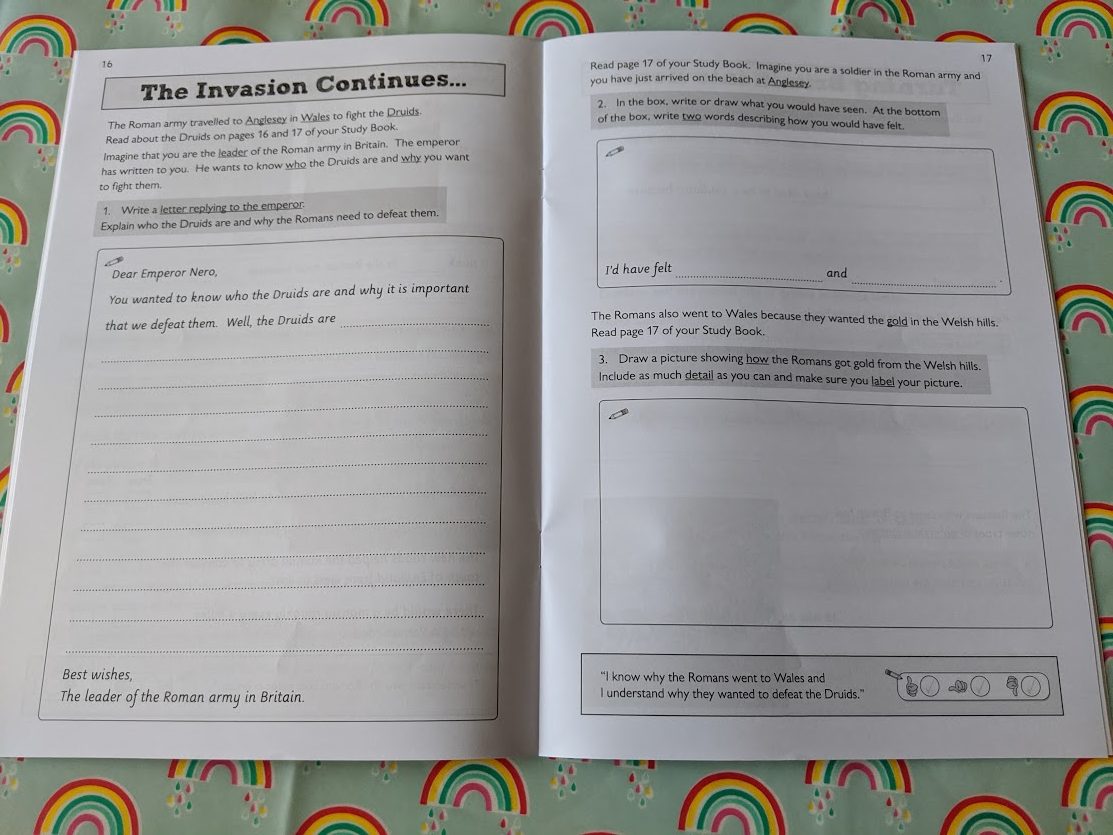
The study books are colour and the activity books are in black and white. Each double-page spread corresponds to a single page in the teacher guide and I use them as one lesson. It’s all presented in a logical way to tell the period of history. There’s a timeline along the top to help place the events as well as questions on each spread to get the children to think about things in more detail. The activity book has a series of questions corresponding to the text and images in the study book and will often ask the children to think about how they would have felt in a situation or to think how things might have changed etc.
The images below show the pages in each book for one particular section.

How I use the books
At the moment, these are pitched for an older age group, so some of the activities the children would struggle with. We tend to read through the study book together and talk about what we can see, what we think or if and I’ll talk through the activity book ideas. A lot of our history work at the moment is mostly talking and crafting some bits here and there. We have done a little creative writing to tie in with bits where I think it might work for them. But at the moment I am using the study guide as a framework for presenting and working through the information. We will probably use the activity books in more detail in the next year or two when they’re a little older. For now, they have given me some ideas of things we can do to consolidate the learning.